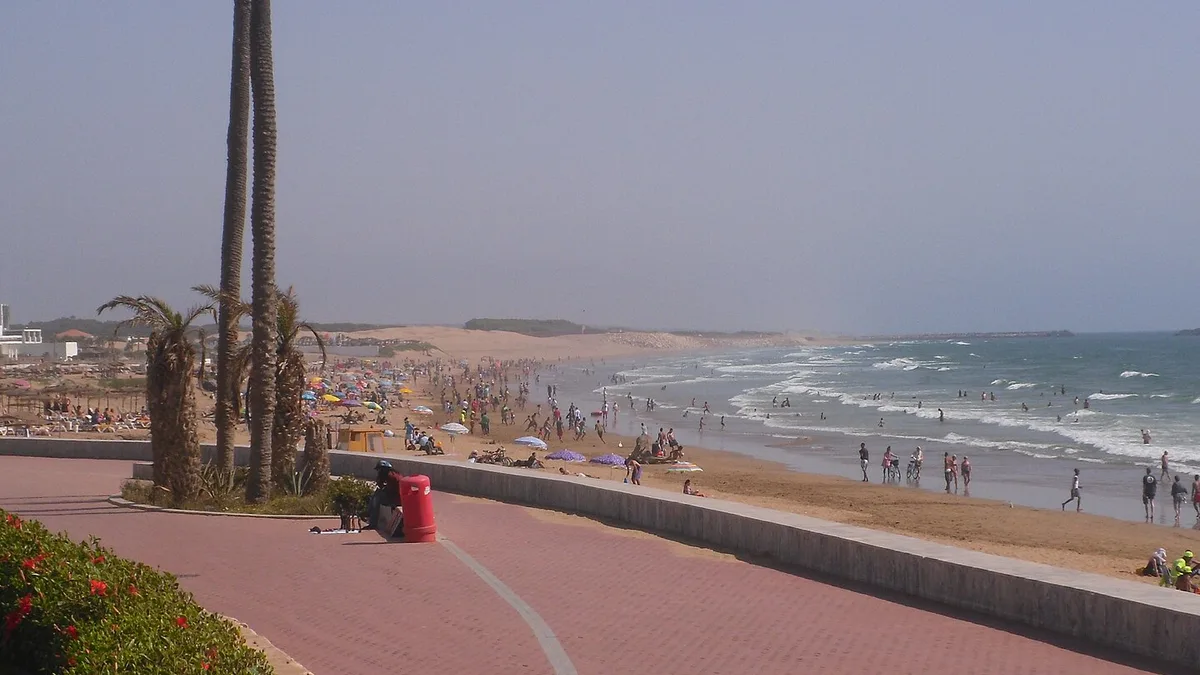
Agadir has a reputation for the same weather all year round. That is true for the beach: the city is among the sunniest in the country and the air temperature varies little on the seafront. It is not true at all for the road.
Between January and August it is not the same routes that are usable, not the same hours that are comfortable, and not the same risks that await. A driver who follows the July programme in February loses a day; one who does the reverse spends it in a cabin at forty degrees.
Winter: the rain and what it does to the rivers
The rainy season runs from November to March. It does not rain often, but when it rains it rains hard and in a short time. That is the classic pattern of southern Morocco, and it has a direct consequence on the road.
Many secondary roads in the Souss and the Anti-Atlas cross the riverbeds by fords, concreted crossings at bed level rather than bridges. Dry, you cross without a thought. After a storm upstream, the same ford can be under fifty centimetres of running water, with depth markers painted on posts.
The rule is absolute and applies to every vehicle, 4x4 included: you do not cross a ford with water running over it. Thirty centimetres of fast water moves a car. Floods in the Souss rise within the hour and fall back within a few hours: waiting is almost always the right decision.
Three other effects of winter:
- Rockfalls on the mountain roads, particularly towards Immouzzer and in the Anti-Atlas. Rarely blocking for long, but stones stay on the road for several days.
- Short days. In December, night falls around six in the evening. Any trip into the mountains has to be planned around that hour, not around dinner.
- Cold at altitude. It is twenty two degrees in Agadir and eight at Immouzzer in the morning. A jacket in the boot changes a walk.
In return, winter and early spring are the best time for Paradise Valley: that is when the pools are full.
Summer: the heat inland
The sharpest contrast in the region is not seasonal but geographic, and summer makes it dramatic. On the Agadir seafront, the Atlantic breeze keeps temperatures bearable all summer. Twenty kilometres inland, in the Souss plain, there is no breeze left.
In July and August the gap between Agadir and Taroudant can reach ten to fifteen degrees in mid afternoon. The plain is closed off by mountains and stores the heat. Three practical consequences:
- Air conditioning stops being a comfort. Test it before leaving the car park, not on arrival at Oulad Teima.
- The hours shift. Inland visits are done early in the morning or after four in the afternoon. Between noon and three you achieve nothing useful in Taroudant in summer.
- Water travels with you. Two litres a person in the boot, for a breakdown or a jam, weigh nothing.
You also have to reckon with the chergui, the continental wind that blows from the south east a few days a year. It pushes the temperature up ten degrees at a stroke, including on the coast, and fills the air with dust. On chergui days visibility drops and the southern roads become uncomfortable.
Sea fog, almost all year
This is the most constant phenomenon on this coast and the most underestimated. Humid Atlantic air meets warm land and forms a dense mist, which climbs the cliffs at the end of the day and clears in mid morning.
It mainly affects the coast north of Agadir, between Cap Rhir and Tamri on the Essaouira road, and the coast to the south between Tiznit and Sidi Ifni. Visibility can fall to fifty metres on bends without barriers.
That is not a reason to cancel a trip, it is a reason to adjust the hour: on those two roads, you leave after nine and you are back before dusk.
Crowds: what the calendar changes
Three periods genuinely load the region's roads:
- July and August, with Moroccan holidaymakers and residents abroad back home. The N1 towards Taghazout is saturated at weekends, and parking in the village is a matter of luck.
- Eid week, when family journeys fill the main roads and many businesses close for several days.
- The European February school holidays, which fill Agadir without loading the hinterland.
Ramadan has a different effect: traffic is calm during the day, then intense in the hour before the fast is broken. That is the moment of the day when drivers are in a hurry. A journey planned for that hour is worth moving by an hour.
The best compromise
If you choose your dates for the road rather than for the beach, aim for March and April or October and November. There is still water in the gorges in spring, the inland heat stays bearable, the days are long enough for a trip south, and the roads are empty.
Whatever the season, two checks before setting off cost nothing and avoid most of the trouble: the air conditioning and the tyres. The criteria for choosing the vehicle are set out in small car, saloon or 4x4 in the Souss.
Coming in summer? Take a car whose air conditioning has been checked recently and leave early. The available models are on the car rental in Agadir page; the terms and the paperwork are in the complete guide to renting in Agadir.
Photo: Elmschrat via Wikimedia Commons, CC BY-SA 3.0.