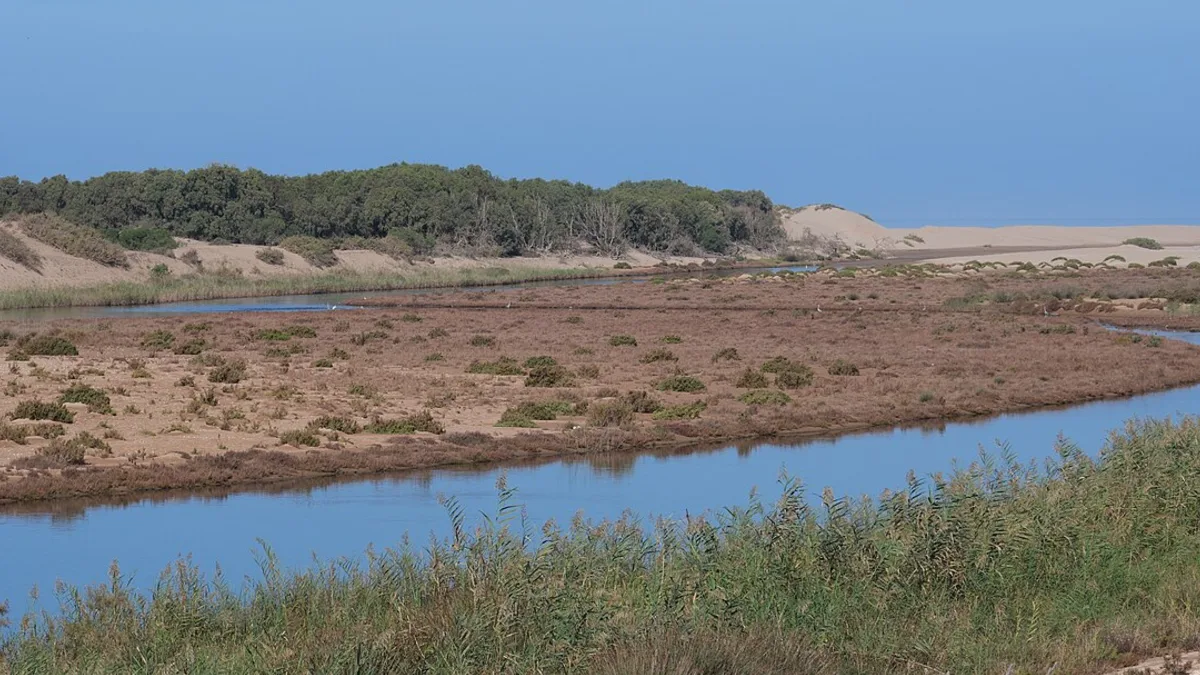
Souss-Massa National Park begins on the edge of Agadir and stretches some sixty kilometres south, as far as the approaches to Tiznit. It is a narrow coastal strip, a few kilometres wide, protecting two river mouths, dunes, a euphorbia steppe and the last viable wild colony of northern bald ibis in the world.
It is also the most underrated trip out of the Souss. You can be there in forty minutes from the centre of Agadir, and most visitors who spend a week in the region have no idea it exists.
Two entrances, two different days
The park is visited from two places that have little in common.
The mouth of the Souss river is the nearer: it touches Agadir, just south of the port, below the royal estate. You reach it by the road along the south bank of the river. It is a mudflat, a brackish stretch of water fringed with tamarisk, and one of the best bird watching sites in Morocco. Flamingos, spoonbills, stilts, curlews, depending on the season. Twenty minutes by car from the seafront, and you are in another country.
The mouth of the Massa river, some sixty kilometres south, is the heart of the park. You get there on the N1 towards Tiznit, then a secondary road towards Sidi Binzarne and Massa. The lagoon there is wider and wilder, and it is around it that the bald ibis feeds.
The route to Massa
- Agadir to Inezgane: 13 km, continuous built up area, heavy traffic.
- Inezgane to the turning: the N1 south, fast, as far as the exit towards Sidi Binzarne around kilometre 40.
- The secondary road: about twenty kilometres to the lagoon. Surfaced for most of it, with narrow sections and village crossings.
Allow an hour from Agadir. You park at the end of the road, near the lagoon; from there it is on foot along laid out paths. Access works have improved the roads to both entrances, and there are places along the way to stop and get out of the car.
The bald ibis: what you can realistically hope to see
The northern bald ibis is a large black bird with green sheen, a bare head and a long curved red bill. It has disappeared from almost all of its former range; the cliffs of Souss-Massa and the area around Tamri hold the largest wild population and the only one considered viable, of the order of a few hundred birds.
A few honest pointers, because this is a sighting you have to earn:
- The birds feed in groups in the steppe and the fields near the coast, and nest on the cliffs. You see them probing the ground more often than in flight.
- Early morning and late afternoon are the best times.
- Binoculars change everything. Without them, a group of ibis at two hundred metres stays a group of black dots.
- It is never guaranteed. The birds move according to the food available. Some visitors see them in ten minutes, others not at all.
The Tamri area to the north, on the Essaouira road, is the other sector where the species is seen. That allows a combination: the mouth of the Tamri river on the northern run, and the Massa lagoon on the southern one.
The rest of the wildlife
The park also holds a reserve where Saharan species that had vanished from the region have been reintroduced: dorcas gazelle, addax, scimitar horned oryx, red necked ostrich. They live in large enclosures, which is not quite observation in the wild but remains a serious conservation programme.
On the bird side, the Massa lagoon is a Ramsar site and takes part of the migration between Europe and West Africa. The richest period runs from autumn to early spring.
What to know before you go
- Take water and a hat. There is no refreshment stand at the mouth of the Massa, and shade is scarce.
- Stay on the paths. This is a protected area and nesting birds are sensitive to disturbance; approaching a colony puts it to flight, sometimes lastingly.
- Do not drive onto the beach. The sand is soft as soon as you leave the compacted track, and a vehicle bogged down in a protected area is a problem on several counts.
- The wind gets up in the afternoon over the lagoon, which makes watching through binoculars harder. The morning is calmer.
A small car is enough for the whole trip: both accesses are surfaced. The only reservation concerns the secondary tracks towards the beach, where ground clearance counts; the subject is covered in small car, saloon or 4x4 in the Souss.
Combining it with the south
Massa sits halfway between Agadir and Tiznit, which makes it a natural stop rather than a separate destination. The arrangement that works best: the lagoon early in the morning, when the birds are feeding, then the road to Tiznit and Mirleft for the rest of the day.
The other way round, coming back from the south, a stop at Massa at the end of the afternoon works well: that is the other window when wildlife is active, and the light on the lagoon is worth the detour even without binoculars.
Leave early and bring binoculars. Those are the two things that decide whether you see anything. A small car is enough for both accesses: the available models are on the car rental in Agadir page, and the formalities in the complete guide to renting in Agadir.
Photo: Timothy A. Gonsalves via Wikimedia Commons, CC BY-SA 4.0.