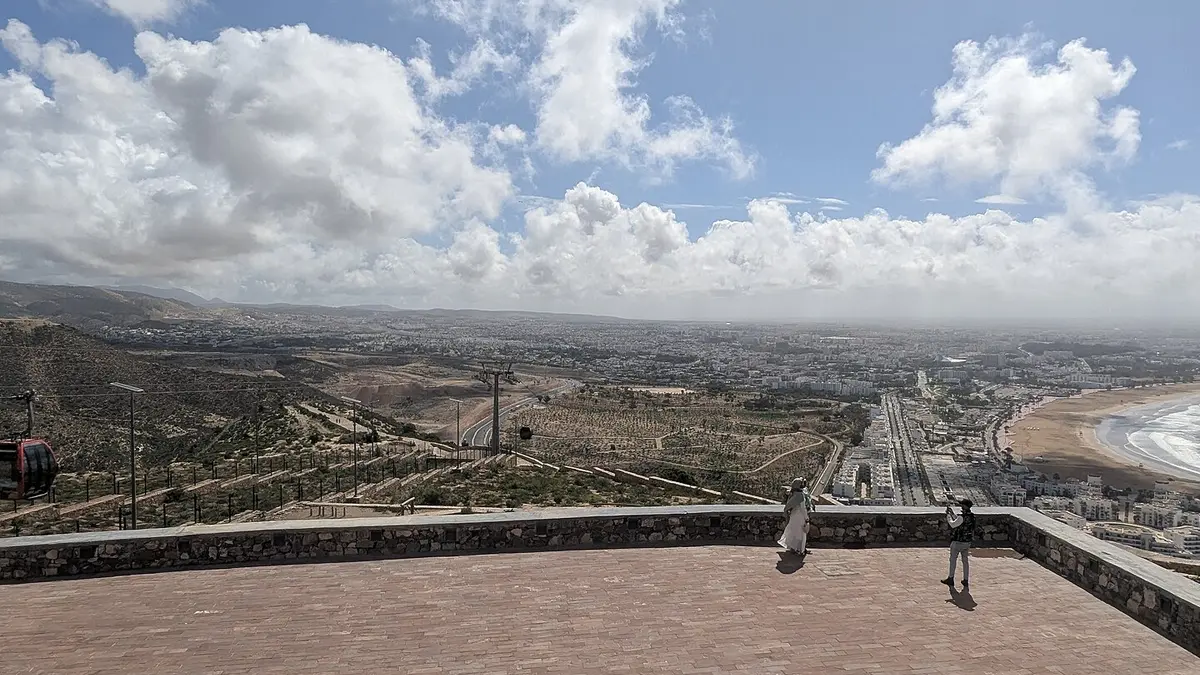
Agadir is easy to drive. The city was rebuilt from scratch after the 1960 earthquake on a grid plan, with wide avenues and roundabouts everywhere. There is no labyrinth of a medina to cross, no treacherous one way street, and the signs are in Arabic and French.
What catches people out is therefore not the city but the customs. A handful of unwritten rules decides how traffic flows here, and nobody explains them at the rental counter. Here they are.
Roundabouts, and the rule that actually applies
Officially, priority goes to whoever is already in the ring. In practice, on the big roundabouts of Agadir, entry is negotiated: you edge forward, you make yourself seen, and you merge into the flow. Three principles work:
- Never accelerate to take a gap. Here, the driver who accelerates is the one who has not understood. You enter at walking pace, which gives everyone time to adjust.
- Keep looking left continuously, not once. Traffic in the ring changes lane without indicating.
- Do not stay in the outer lane if you are going more than a quarter of the way round: you will be cut off by the exits.
Indicators are little used, including when leaving a roundabout. Assume the vehicle in front of you may exit without warning, and keep a bigger gap than you would in Europe.
Speed limits and checks
The limits are the usual ones: 60 km/h in built up areas, 100 km/h on the open road, 120 km/h on the motorway. Some urban stretches of Agadir are 40.
What is worth knowing is where the checks are. The royal gendarmerie sets up mobile speed traps in recurring places, almost always the same ones:
- Just before town entrances, where the limit drops from 100 to 60 over a few dozen metres.
- On the N1 south of Agadir, at the end of overtaking stretches.
- Coming out of the roundabouts at the town entrances, on a downhill.
Fixed roadside checks, with several officers and a cone, are frequent too. You slow down, lower the window, and show your licence, the registration document and the insurance certificate if asked. The rental contract serves as proof that you are entitled to the car; keep it in the glove box and not in your suitcase. Most of the time you are waved through.
If you are fined for speeding, it is paid on the spot and you are given a receipt. Insist on the receipt: it is the proof that the fine has been settled, and it is what stops you being charged twice.
Parking and the attendants
In the centre, along the seafront, at the port and in front of the big markets, you will meet men in fluorescent vests waving you into a space. These are the parking attendants, a local institution. They place the cars, keep an eye on them, and collect a few dirhams when you come back.
A few pointers so you do not get it wrong:
- You pay on leaving, not on arriving. An attendant who asks before you go is probably not one.
- The amount is small, more for a full night or a long evening.
- Carry coins. Nobody has change for a large note, and the wait is yours.
Paid blue bays exist in some streets in the centre. Delivery zones are marked and the police enforce them: half an hour parked there costs you a wheel clamp.
Fuel: where, what, how
Filling stations are plentiful in town and on the roads leading out of it. Almost all of them have attendants: you stay at the wheel, say which fuel and how much or ask for a full tank, and pay. Card payment is common in town, much less so in rural areas; keep cash.
Most rental cars in the region run on diesel, which remains cheaper than petrol. Check the fuel flap when you collect the car rather than asking the pump attendant: putting in the wrong fuel is never covered by insurance.
Prices per litre are displayed and change regularly. They are slightly higher at isolated stations inland than in Agadir itself, which is normal and not worth arguing about.
Six traps in the first few days
- Speed bumps. High, frequent, often poorly signed and sometimes unpainted. They are the leading cause of underbody damage on a rental car.
- Unlit scooters. Very present in the evening in the Talborjt and Al Houda districts.
- Pedestrians crossing away from the crossings. That is the custom, not the exception.
- Carts and tractors on the eastern exit towards Aït Melloul, often without reflectors.
- Sand on the road near the seafront after a windy day: it cuts grip in bends.
- Low sun in the morning heading east and in the evening coming back west. On the airport axis it is blinding at certain hours.
Driving at night
In town, no problem: Agadir is well lit. Outside it is another matter. The roads of the Souss have no lighting, few barriers, and you meet farm vehicles without lights and animals. The rule local people follow is simple: trips into the mountains and to the south finish before dark.
That is also why a flight landing late deserves some thought when choosing between the airport and the city to collect the car; the question is covered in renting a car at Agadir Al Massira airport. For the rest, the choice of model depends mostly on where you are going: see small car, saloon or 4x4 in the Souss.
The best advice for Agadir comes down to one word: small. A small car slips through, parks easily and clears the speed bumps without scraping. The available models are on the car rental in Agadir page, and the rest of the formalities in the complete guide to renting in Agadir.
Photo: Abdeaitali via Wikimedia Commons, CC BY-SA 4.0.