Paradise Valley is not a valley, it is a gorge. The Oued Tamraght has cut into the limestone over several kilometres, leaving a chain of pools between vertical walls and palm trees. It is about thirty kilometres from Agadir as the crow flies and an hour and a quarter by road, because in between there are eight hundred metres of altitude and a road that never stops turning.
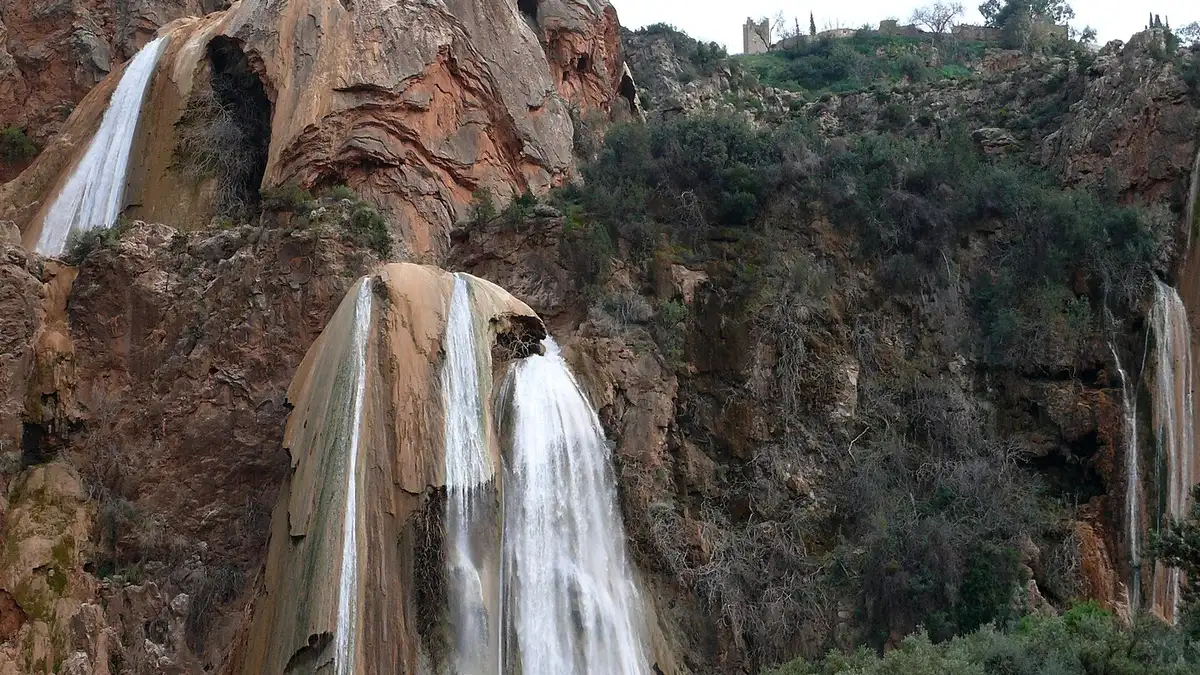
Higher up the same road, Immouzzer des Ida Outanane is a mountain town at 1,200 metres with a waterfall that flows when there is water to flow. Both fit into one day. You just need to know what you will find, because this is the trip in the Souss that disappoints most often, and always for the same reason.
The route from Agadir
Leave Agadir northbound on the N1 as far as Aourir, at kilometre 12. Just past the village a road turns inland along the river: that is the Immouzzer road. From there, forget national-road averages.
The road is surfaced but narrow, with no barrier along long sections, hairpin bends and stretches barely a lane and a half wide. You will meet vans, tour coaches and, in the villages, donkeys. Realistic speed is around forty kilometres an hour.
- Aourir: kilometre 12 from Agadir, the last convenient filling station before the mountains.
- Paradise Valley access: about twenty kilometres past Aourir. You park on the roadside near the bridge; the walk down to the pools takes fifteen to twenty minutes.
- Immouzzer des Ida Outanane: around 56 km from Agadir, an hour and a half with stops.
One tip that saves fuel and frustration: fill up at Aourir. Between there and Immouzzer the options are very limited, and the road uses more than you would expect because of the climbing.
What you need to know about the water
This is the reason for the disappointments. Paradise Valley depends entirely on rain that has fallen upstream, and the Oued Tamraght does not run year-round along its whole length. The real calendar looks like this:
- February to May, after the winter rains, the pools are full and the water is clear. That is when the place earns its name.
- June and July, the level drops but the larger pools still hold.
- August to October, after a dry summer, there may be nothing but green puddles. People drive an hour and a half to look at a bed of stones.
- After a heavy storm the opposite applies: the river rises fast and swimming becomes dangerous. A flash flood in these gorges does not give you time to climb out.
There is no official water-level bulletin. The useful habit is to ask the day before at your accommodation or in a café in Aourir: local people know whether the water is there, because everyone goes up at the weekend.
The same logic applies to the Immouzzer waterfall, which is dry for much of the year and spectacular for a few weeks in spring. Almost all the photographs you have seen were taken in March.
The walk down and the pools
A path drops from the road into the bottom of the gorge. It is not mountaineering, but it is rock, sometimes slippery, and the climb back is in full sun. Closed shoes beat flip-flops, and a bottle of water each is not excessive.
At the bottom, several pools follow one another. The first are the busiest; walking twenty minutes further upstream almost always finds space. Young men from the village offer to guide, sometimes insistently: agree the fee before setting off, not on the way back.
A few small cafés have set up on terraces above the water at the bottom of the gorge. They serve tea, tagines and juice. It is simple and expensive for what it is, but the setting earns it.
Carrying on to Immouzzer
Past the valley, the road keeps climbing for another thirty kilometres to Immouzzer des Ida Outanane. Argan trees give way to fig and olive, and the landscape opens onto cultivated terraces clinging to the slopes.
The town is known for its honey, sold in the shops along the main street and celebrated at its own moussem. The viewpoint over the valley, on the way out of the village, justifies the last few kilometres on its own — even when the waterfall is dry.
Which car, and when to head back
A small hatchback climbs this without trouble: the road is surfaced all the way to Immouzzer. Ground clearance only becomes an issue if you leave the tarmac for a secondary access to the pools after a flood, when the track is washed out. The categories are compared in the complete guide to renting a car in Agadir.
The genuinely important point is the time you start back. This road is bad after dark: no lighting, no barriers, blind bends and animals on the carriageway. Plan to be back down at Aourir before sunset. If you are combining it with the coast, do it in that order — Taghazout and Tamraght in the morning, the mountains in the afternoon, and down before dark.
A day in the mountains needs a little more thought. Check the air conditioning and the tyres before you climb, and fill up at Aourir. The available cars are on the car rental in Agadir page; if you would rather drive the coast, Legzira and Sidi Ifni is the trip in the other direction.
Photo : TerrierMichel via Wikimedia Commons, Public domain.